

הבלוג · רימקס בעיר
Real Estate in Herzliya: The Complete Guide for Buyers, Sellers and Renters (2026)
בקצרה
Real estate in Herzliya spans luxury sea-view apartments in Herzliya Pituach, family neighborhoods in Herzliya Ha'yeruqa, and urban-renewal buildings throughout the older parts of the city. The market is sophisticated and price-sensitive — buyers and sellers who work with a local agent familiar with every neighborhood consistently outperform those who rely on national portals alone.
Herzliya is not a single market. Walk ten minutes from the seafront promenade in Herzliya Pituach and you are in a neighborhood where families have lived for forty years and urban-renewal projects are changing the skyline one building at a time. Walk another ten minutes and you are in Herzliya Ha'yeruqa — quiet, green, and popular with families who want space without leaving the city. Getting Herzliya's real estate right means understanding which neighborhood you are actually talking about and why the same search result on a national portal can represent very different realities depending on which side of Route 2 the property sits.
This guide covers what the Herzliya market looks like in 2026, how to navigate the buying and selling process as an international buyer or a first-time seller, and what local expertise actually adds to a transaction — factually and without shortcuts.
The Herzliya Real Estate Market in 2026
Herzliya sits on the Mediterranean coast, roughly fifteen kilometers north of Tel Aviv, at the northern edge of the Sharon region. The city draws three overlapping buyer profiles: high-tech professionals employed at the nearby Park HaMada (Science and Technology Park), families upgrading from Tel Aviv or other Sharon cities, and international buyers — Israelis returning from abroad, overseas investors, and English-speaking expats — drawn by the coastline, quality of life, and proximity to Ben Gurion Airport.
Each of these profiles targets a different part of the city. The tech and finance crowd concentrates in Herzliya Pituach and the Marina. Families with school-age children weigh Herzliya Ha'yeruqa, Neve Amal, and Galil Yam. Buyers who want Herzliya's advantages at a lower entry price look at Herzliya B and Herzliya Ha'tzeira — neighborhoods that also carry the highest urban-renewal potential, which can mean future upside or construction disruption, depending on the timing and the specific building.
The market in 2026 is shaped by several forces simultaneously: persistently high demand driven by tech employment, a meaningful supply of urban-renewal projects adding new apartments to older neighborhoods, and a rising cost of borrowing that has made buyers more cautious. The result is a market where well-priced, well-presented properties sell relatively quickly, while overpriced listings sit for months and lose negotiating power with every passing week.
One structural feature worth knowing: Herzliya has very little undeveloped land. New supply comes primarily from urban renewal — demolishing and replacing existing buildings — rather than greenfield construction. That means the texture of each neighborhood is changing from within, not expanding outward. For buyers, it also means that understanding a building's urban-renewal status is not optional due diligence; it is a core part of knowing what you are actually buying.
Herzliya's Neighborhoods — A Buyer's Map
Herzliya has six distinct residential areas. Each has a different character, a different buyer profile, and a different price dynamic. The summaries below describe what each area feels like and what kind of property you typically find there — not price tables, which change and which a local agent will calibrate to the specific property you are considering.
Herzliya Pituach, Nof Yam, and the Marina
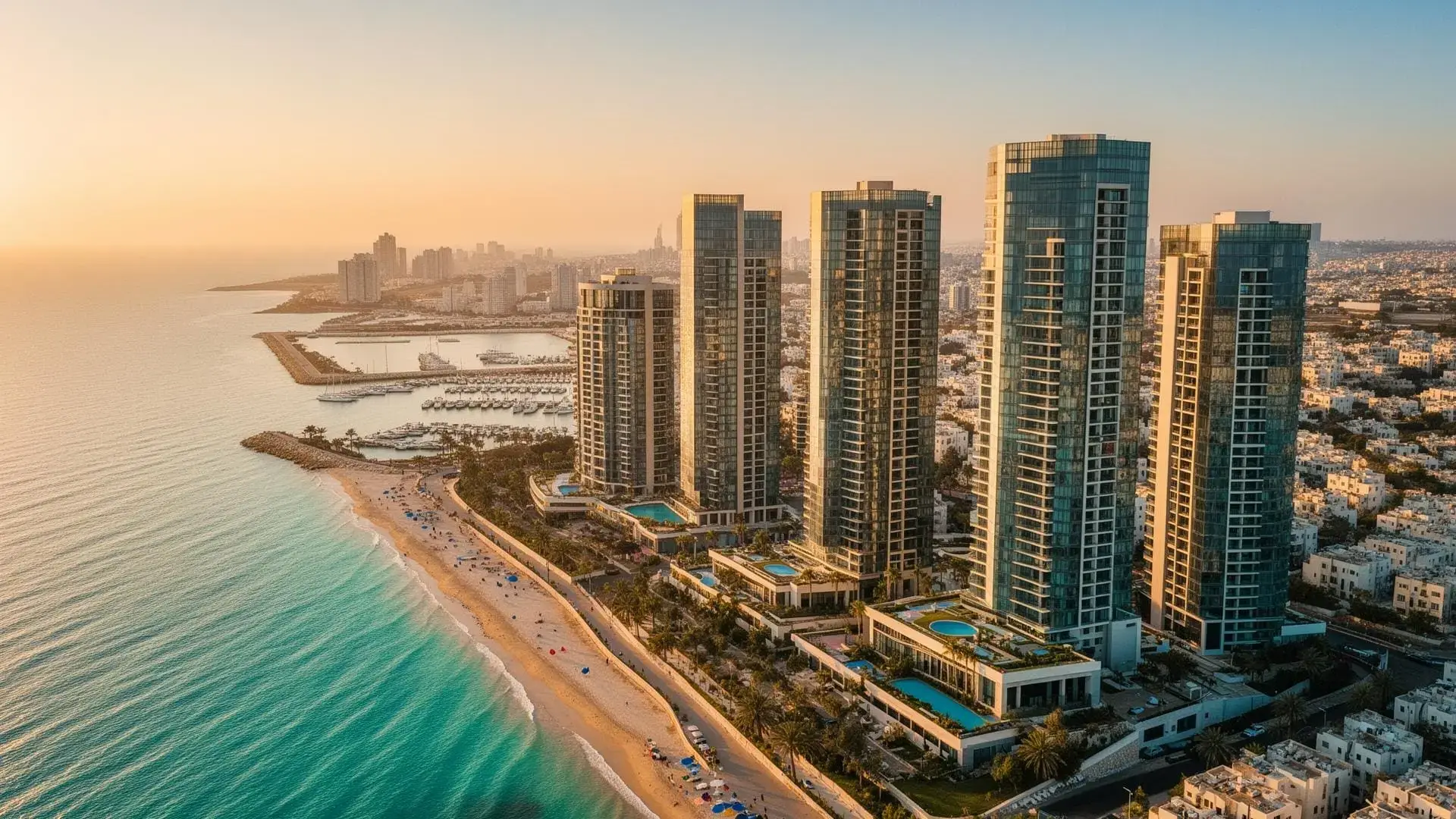
Herzliya Pituach occupies the coastal strip west of Route 2. It includes the Marina — a modern development of high-end residential towers, restaurants, and a working marina — and Nof Yam (Sea View), a quieter hillside neighborhood where villas and apartment buildings look directly over the Mediterranean. This is Herzliya's premium address: the highest prices per square meter in the city, predominantly newer or renovated buildings, and a significant proportion of international buyers and owners.
The Marina deserves a separate note. Some units there are classified as vacation apartments (dirat nofesh) rather than residential, which affects whether you can take out a standard residential mortgage, use the unit as a primary residence year-round, or rent it out short-term under Israeli tax and planning law. If you are considering a Marina purchase, verify the property's classification in the building file (tik binyan) before making an offer. This is not a formality — it determines what the property can legally be used for.
Herzliya B (Bet)
Herzliya B is the established residential neighborhood east of the city center. The building stock is predominantly from the 1970s to the 1990s — four to twelve-story apartment buildings that are now candidates for Tama 38 or Pinui-Binui urban renewal. Many buildings are already in some stage of planning or negotiation, which creates both opportunity and uncertainty for buyers. A building deep in a renewal process carries future value potential; it also means construction nearby, longer planning timelines, and legal complexity that requires an attorney familiar with urban renewal.
For buyers who want to be in Herzliya without the premium of Pituach, Herzliya B offers a meaningful entry-price difference. The neighborhood is well connected to public transport and close to the city center; the schools, parks, and amenities that families look for are accessible.
Herzliya Ha'yeruqa (the Green) and Ha'maaravit (the Western)
Herzliya Ha'yeruqa is a family-oriented neighborhood of lower-density buildings, parks, and a school catchment that draws buyers specifically for the primary school options. It is quieter and more residential than Herzliya Pituach, with strong demand from families with children. The Western extension adds private houses and garden apartments. Both areas are popular with Israeli professionals who want space and quiet without the coastal premium.
Herzliya Ha'tzeira (Young Herzliya) and Neve Amal
Herzliya Ha'tzeira is the older part of the city and arguably the most active urban-renewal zone. Tama 38 projects and Pinui-Binui processes are running on multiple streets simultaneously. For buyers: a newly built or reinforced apartment in this area is substantially newer than the surrounding stock and comes with a statutory warranty period. For existing owners: the decade ahead will likely change the neighborhood's character significantly. Neve Amal, adjacent and similarly priced, follows the same pattern — older stock, active renewal, and a community feel that longer-term residents are protective of.
Galil Yam
Galil Yam sits in the northern part of Herzliya and is less known to buyers coming from outside the city. It is green, quiet, has a well-regarded primary school, and is reasonably close to the beach. It tends to attract buyers who have researched Herzliya's neighborhoods thoroughly and want a more residential pace than Herzliya Pituach, at a lower price. The supply of available properties is lower here than in other neighborhoods, which means transactions often require a local agent who knows what moves quietly without appearing on the national portals.
Buying Property in Herzliya — Step by Step
Israeli real estate transactions follow a defined structure. The steps below apply whether you are buying as an Israeli resident, a returning Israeli, or a foreign national. The main differences for non-residents are in the tax treatment and the financing options, which are covered below.
- Get mortgage pre-approval (ishur ikroni) first. Israeli banks will not commit to a mortgage without this step. Pre-approval tells you the maximum purchase price you can realistically finance — essential before investing time in viewings at a price you cannot close.
- Define your full budget — total acquisition cost, not just the asking price. Budget for purchase tax (mas rechisha), attorney fees on both sides, agent commission, and moving costs. These are real costs that add up.
- Work with a local agent. National portals show publicly listed inventory. Local agents in Herzliya know about properties that are about to be listed or that owners prefer to sell quietly without a public listing. At Herzliya prices, the difference between a well-negotiated and a poorly-negotiated purchase is material.
- Conduct due diligence before any offer. Pull the property's land registry extract (nesach tabu), request the building file (tik binyan) from the municipal building department to verify what was built with a permit, and confirm the urban-renewal status. If anything is unclear, an independent structural inspection (bdek bait) before signing protects you.
- Submit an offer through your agent. In Herzliya, verbal offers rarely lock a property. A preliminary written agreement (zichron dvarim) followed quickly by a full purchase contract (chozeh mekhar) is the norm. A zichron dvarim is a legally binding document — do not sign one without your attorney reviewing it first.
- Sign the purchase contract and pay in stages. Israeli purchase contracts typically involve two to three payment installments: a deposit at signing, a payment upon mortgage approval, and final payment at handover. Your attorney ensures each payment is protected by a bank guarantee or registered title note.
- File and pay purchase tax (mas rechisha) to the Israel Tax Authority within the statutory deadline. Your attorney handles this filing.
- Register the property in your name in the Land Registry (Tabu) or the Israel Land Authority. This is the final step that confirms your ownership legally.
For overseas buyers and non-residents, two additional steps are standard: a notarized and apostilled Power of Attorney (iyuf koach) that authorizes a representative in Israel to act on your behalf during the transaction, and confirmation of the bank-to-bank transfer process for purchase payments. Your attorney will specify what the receiving bank requires.
Costs to Budget for Beyond the Asking Price
The asking price is the starting point, not the total cost. Every buyer in Israel should budget for the following additional items. Exact amounts vary by transaction value, buyer profile, and the specific terms negotiated:
- Purchase tax (mas rechisha): A tiered tax on the purchase price, paid to the Israel Tax Authority. The rate depends on the purchase price, whether this is your first or additional property, and whether you are an Israeli resident or a foreign national. The Israel Tax Authority publishes current brackets. Check there, or have your attorney calculate the exact figure for your situation before you commit.
- Attorney fees: In a standard Israeli real estate transaction, each side pays their own attorney. Get a written fee proposal before engaging.
- Agent commission: The market range is approximately 1-2% plus VAT per side. Confirm the exact amount in writing before signing an agency agreement.
- Betterment levy (heitel hashvacha): Applicable in some cases where a property has received planning benefits. Your attorney will check whether this applies to the specific property.
- Property inspection and surveys: Optional but recommended for older buildings or any property where you have structural concerns.
- Mortgage arrangement fees and property appraisal: Israeli banks charge processing fees and may require an independent appraisal. Your mortgage advisor will detail these.
For non-resident buyers: Israel does not restrict foreign nationals from purchasing real estate, but the purchase-tax brackets for non-residents are structured differently from those for Israeli residents purchasing their first property. The difference is meaningful at Herzliya price levels. An Israeli tax attorney can calculate the exact amount for your transaction before you commit.
Selling Real Estate in Herzliya — What This Market Demands
Herzliya buyers are experienced. Many have already bought or rented in the area, they compare properties across multiple neighborhoods, and they know when a listing is overpriced. A property that enters the market at the wrong price rarely corrects — it sits, loses momentum, and eventually sells for less than a correctly-priced listing would have achieved in the first week.
Pricing correctly from day one is strategy, not caution. A local Herzliya specialist has access to closed transaction data from the Israel Land Authority — not just asking prices on national portals — and can tell you what properties like yours actually sold for in the past six to twelve months, by neighborhood and building type. That distinction matters enormously at high price points.
Preparing the Property
Presentation matters more in a sophisticated market. Clean, decluttered, well-lit apartments with professional photography generate significantly more viewings in the first two weeks than listings with phone photos. In a price range where the difference between a strong offer and a weak one is material, the cost of professional preparation is returned many times over.
For properties in Herzliya Ha'tzeira or Herzliya B: know your building's urban-renewal status before listing. A building with an approved Tama 38 or Pinui-Binui plan attached to the listing attracts a different — and often more motivated — buyer profile than one without it. Your agent should present this proactively, not wait for a buyer to ask.
Capital-Gains Tax for Sellers
Sellers in Israel may be liable for capital-gains tax (mas shevach) on the appreciation of the property since purchase. There are exemptions — most notably for sellers of a single residence who meet the statutory conditions — and deductions for documented improvements and certain selling costs. The calculation depends on your specific purchase date, price, ownership structure, and prior use of exemptions. An Israeli tax attorney should review your situation before you list, not after you have accepted an offer. The tax implications can materially affect how you price and structure the transaction.
Renting in Herzliya — What Tenants and Landlords Should Know
Herzliya's rental market is active year-round, driven by the same tech employment base that supports the purchase market. The rental pool includes apartments across all neighborhoods, with higher concentrations near the Herzliya train station (convenient for commuters), in Herzliya Pituach (short-term and long-term expat rentals), and in family-oriented neighborhoods where tenants are not yet ready to buy.
Rental prices in Herzliya vary significantly by neighborhood, size, floor, and whether the apartment has parking, a safe room (mamad), and elevator access. Quoting a specific average here would be misleading — the same two-bedroom apartment can carry very different rent depending on whether it is in a renovated building in Herzliya Pituach or an older walk-up in Ha'tzeira. A local agent can give you the current range for the specific type and location you are targeting, based on what is actually transacting.
For landlords: the Israeli rental market is governed by Tenants Protection legislation that sets minimum standards for lease agreements and limits on security deposits. An agent who manages long-term rental relationships will help you price correctly, vet tenants thoroughly — employment verification, bank statements, guarantors — and draft an agreement that protects your interests without running into tenant-rights issues.
Urban Renewal in Herzliya: Tama 38 and Pinui-Binui
Urban renewal is reshaping large parts of Herzliya. It is relevant to every buyer and seller in the older parts of the city, and understanding the basics prevents costly surprises.
Tama 38 is a national plan that allows aging apartment buildings — generally those built before 1980 — to undergo structural reinforcement against earthquakes, in exchange for allowing the developer to add extra floors. There are two tracks: reinforcement and addition (Tama 38/1), and demolition and reconstruction (Tama 38/2). In Herzliya, both tracks are active across Herzliya B, Ha'tzeira, and Neve Amal.
Pinui-Binui (evacuation-reconstruction) is a larger-scale process where an entire cluster of buildings is demolished and replaced with a new development. Residents are relocated during construction and return to a larger new apartment. The process takes years — from initial developer contact to handover of new apartments, timelines typically measure in a decade or more. The value for existing owners, if the deal is structured fairly, can be substantial; the process requires careful independent legal advice before signing any developer agreement.
For buyers: if a building you are considering is in a Pinui-Binui process, check what stage it is at, whether the residents' agreement is signed, and what the developer's track record in comparable projects is. A building at the planning stage and a building with a signed agreement and approved building permit are very different propositions. Your attorney can request the relevant documents from the municipality.
Why a Local Herzliya Agent Makes a Material Difference
A national portal or a generalist agent can show you what is publicly listed. They cannot tell you that the apartment two floors above a listing you are considering is about to list at a better price, that the building across the street is in a contested Pinui-Binui negotiation that will affect the block for years, or that the school catchment boundary for the neighborhood's most sought-after primary school runs along a specific street and not the one the listing mentions.
These are the things that change the outcome of a transaction, and they come from years of closing deals in the same streets. For sellers, the equivalent knowledge is knowing who the active buyers are for a specific property type, what price signals they are sending, and how to structure and present a listing to reach them specifically rather than broadcasting to a generic pool.
RE/MAX בעיר is a boutique office operating in Herzliya, Ramat HaSharon, Ra'anana, and Kfar Shmaryahu under principal Asaf Reem, who has been active in the Herzliya market for years. The office works across Herzliya's neighborhoods — from investment apartments in older buildings to luxury properties in Herzliya Pituach and the Marina. It handles transactions in English for international buyers, managing the Power of Attorney coordination and attorney referral for buyers based outside Israel.
For buyers: the office provides access to off-market and pre-market inventory alongside due-diligence support that prevents the expensive surprises that catch buyers who navigate without local guidance. For sellers: pricing analysis based on closed transactions, professional photography, and targeted marketing that reaches the specific buyer profile for each property.
שאלות נפוצות
What are the best neighborhoods in Herzliya to buy property?
There is no single answer — the best neighborhood depends on your priorities. Herzliya Pituach and the Marina offer premium sea-view properties at the city's highest prices. Herzliya Ha'yeruqa (the Green) attracts families who want space and access to sought-after primary schools. Herzliya B and Ha'tzeira offer more accessible entry prices with urban-renewal upside. Galil Yam is quiet, community-oriented, and underappreciated by buyers coming from outside the city. A local agent can match your actual requirements to the right area rather than defaulting to the most-marketed neighborhood.
How much does property cost in Herzliya?
Property prices in Herzliya vary significantly by neighborhood, building age, floor, and amenities. Herzliya Pituach commands the highest prices per square meter; older buildings in Herzliya B and Ha'tzeira are lower. Rather than citing averages that may not match the specific property you are considering, the Israel Land Authority publishes closed transaction data by area and property type. For an accurate estimate of a specific property, a local agent's comparative analysis or a certified appraiser is the right source.
Can foreigners and non-residents buy property in Herzliya?
Yes. Israel does not restrict foreign nationals from purchasing real estate. Non-residents pay purchase tax at a different rate from Israeli residents buying a first home, and the mortgage options available to them differ from those for Israeli residents. An Israeli tax attorney and a mortgage advisor experienced with international clients will give you the current rates and the process for your specific situation. The purchase process otherwise follows the same legal steps as for Israeli residents.
What is the buying process for real estate in Herzliya?
The standard process starts with mortgage pre-approval (ishur ikroni), then property search and due diligence — land registry extract, building file, urban-renewal status — followed by a preliminary agreement (zichron dvarim), a full purchase contract (chozeh mekhar), staged payments, purchase-tax filing, and final registration in the Land Registry. For non-residents, a notarized Power of Attorney is also required. A straightforward transaction typically takes two to three months from accepted offer to closing; complications extend that timeline.
What is Tama 38 and how does it affect buying an apartment in Herzliya?
Tama 38 is a national urban-renewal program allowing older buildings to be structurally reinforced or demolished and rebuilt in exchange for the developer adding additional floors. In Herzliya, it is active primarily in Herzliya B, Ha'tzeira, and Neve Amal. If you are buying in an older building, check whether it is in a Tama 38 or Pinui-Binui process, what stage it is at, and what the implications are for you as a new owner. Your attorney can request the building file and planning documents from the municipality.
Do I need a real estate agent to buy or sell in Herzliya?
You are not legally required to use one. However, the Herzliya market has enough complexity — neighborhood micro-differences, urban-renewal implications, off-market inventory, and negotiation dynamics — that most buyers and sellers who navigate it without local representation leave value on the table. Agent commission is paid at closing, so the cost is tied to a completed transaction. Verify that any agent you engage is licensed through the Ministry of Justice broker registry before signing anything.
What is the difference between Herzliya Pituach and the rest of Herzliya?
Herzliya Pituach is the coastal strip west of Route 2, known for sea-view apartments, the Marina, premium dining and leisure, and proximity to the tech park. The rest of the city — Herzliya B, Ha'tzeira, Ha'yeruqa, Neve Amal, Galil Yam — sits east of Route 2 and is primarily residential. The two sides attract different buyer profiles, have different price levels, different building stock, and different urban-renewal dynamics. Many buyers who contact a Herzliya agent have already decided which side of that divide they are targeting; others discover during the search that inland Herzliya better matches their actual priorities.
רוצים לדעת כמה הנכס שלכם שווה — לפני שאתם מחליטים משהו?
השאירו שם וטלפון, וסוכן שמכיר את האזור שלכם יחזור עם הערכת שווי מבוססת עסקאות אמת. ללא עלות וללא התחייבות.
ללא עלות וללא התחייבות · הפרטים נשמרים אצלנו בלבד.
עוד מהבלוג — קשור לנושא
הבהרה חשובה
המידע במאמר זה הוא כללי ומערכתי בלבד, נכון למועד כתיבתו, ונועד להעשרה והתרשמות ראשונית בלבד. אין לראות בו — ואין להסתמך עליו כעל — ייעוץ משפטי, מיסויי, פיננסי, תכנוני, הנדסי, שמאי או תחליף לייעוץ מקצועי פרטני המותאם לנסיבות שלכם. כל מקרה נבחן לגופו, והכללים והמחירים משתנים מעת לעת. לפני קבלת החלטה או ביצוע עסקה יש להיוועץ באיש מקצוע מוסמך (עו״ד, יועץ מס, שמאי, יועץ משכנתאות וכד׳). רימקס בעיר הרצליה והכותבים לא יישאו באחריות לכל פעולה או נזק שייגרמו כתוצאה מהסתמכות על האמור.